
January 2026
Engineering Tips: Snow Load Changes for ASCE 7-22
As the current standard code ASCE 7-16 (IBC 18 and IBC 21) transitions to ASCE 7-22 (IBC 24) major changes include updated snow maps, new thermal factor calculations, a new winter wind factor and an update to the rain on snow surcharge. The snow importance factor has been eliminated and new ground snow maps for each risk category have been provided. The new maps include significant additional historic snow load data greatly reducing Case Study regions. Ground Snow Loads are calculated based on site-specific target reliability indexes for a 50-year reference period.
Here is an example of the Risk Category II ground snow loads:
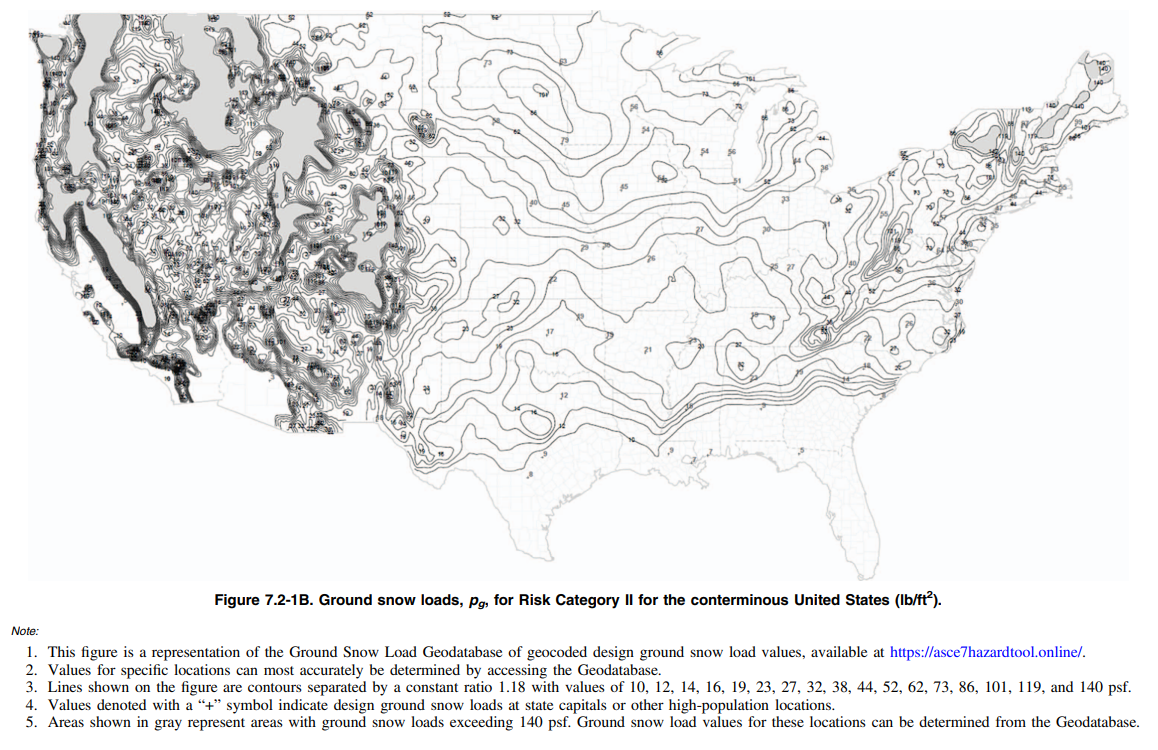
New Ground Snow Loads are 12% higher on average, however some locations could be much higher, and other locations could be lower. Actual differences depend on the location and risk category.
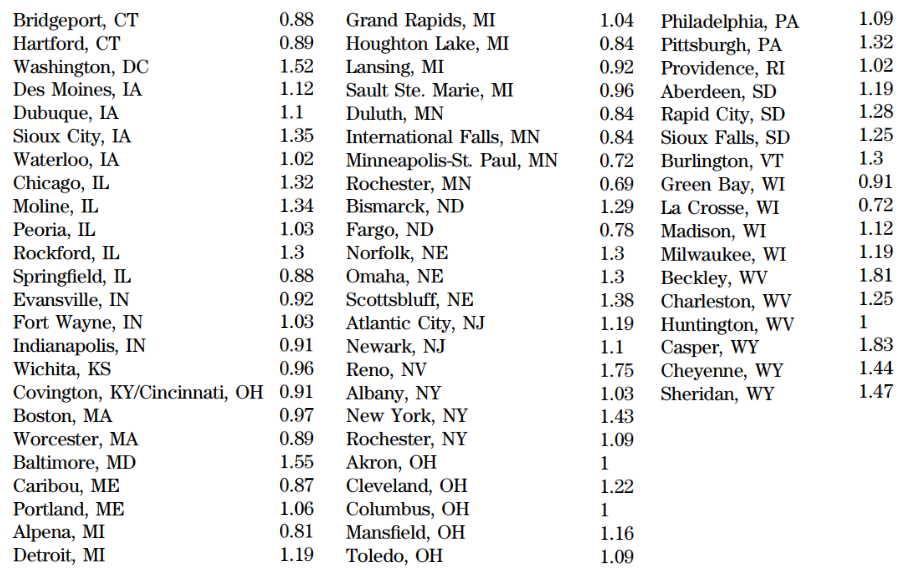
Ratios for ASCE 7-22/ASCE 7-16 ground snow loads for various cities are listed below:
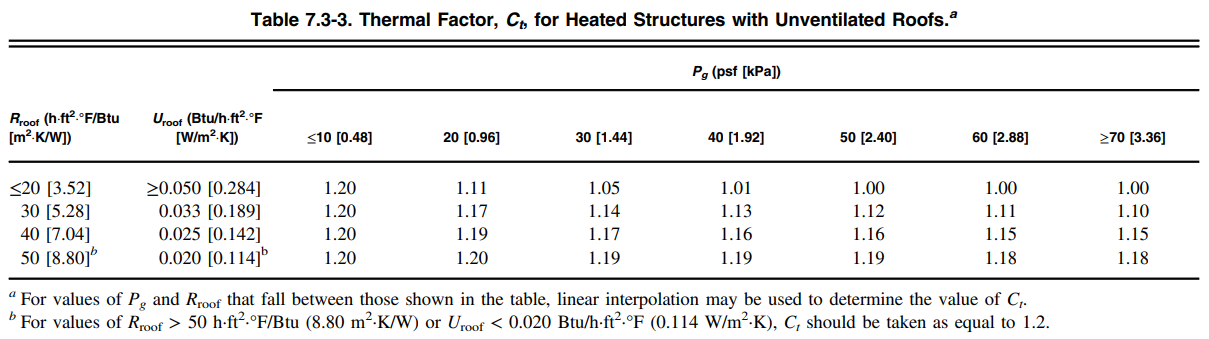
The Thermal Factor Ct has changed from the standard 1, 1.1 and 1.2 in the previous code to a value based on roof R-value and ground snow load from new Table 7.3-3 for heated structures, linear interpolation may be used. Higher roof R-values lead to higher thermal factors used in roof snow calculations.
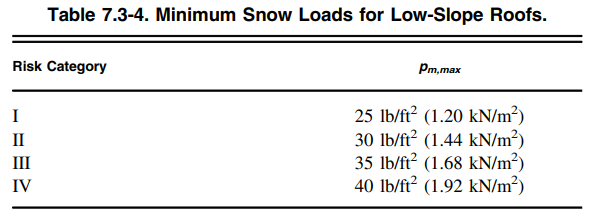
There are new Minimum Snow Loads for Low-Sloped Roofs for each Risk Category in new Table 7.3-4. These are the maximum values of minimum snow that are applied to monoslope, hip and gable roofs with slopes less than 15 degrees. If ground snow values are less than these values, the minimum snow need not exceed the ground snow value. These values used to be the snow importance factor times the ground snow load where the ground snow load is 20 psf or less, or the snow importance factor times 20 psf when the ground snow load exceeds 20 psf.
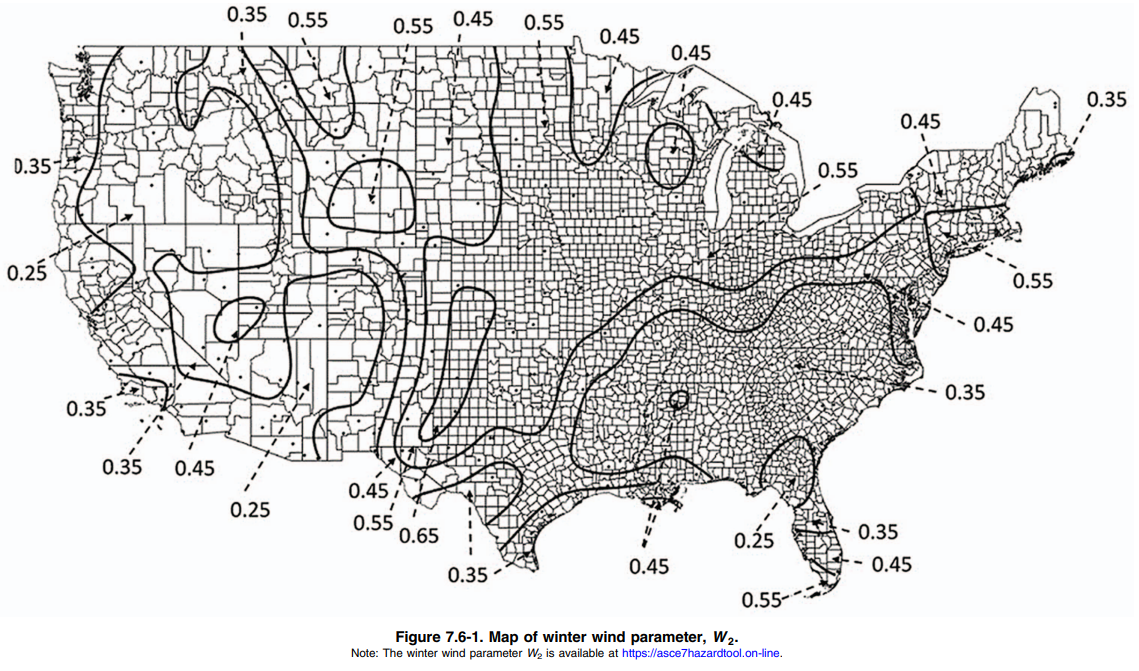
Snow drift height hd is now determined with the new Winter Wind Parameter W2 that accounts for the variability of winter wind speeds on drift loads. Winter wind is defined as the percentage of time during the winter (October – April) when the wind speed is greater or equal to 10 mph, the nominal threshold for wind-induced snow drifting. Unbalanced snow is impacted by winter wind since the rectangular surcharge is based on drift height hd. Windward drift widths increased in Section 7.7.1. Windward and Leeward drifts shall be checked independently to determine which controls.
New map for Winter Wind Parameter W2 in Figure 7.6-1.
Rain-On-Snow Surcharge Load increased to 8 psf in Section 7.10. This used to be 5 psf in previous codes.
In summary, the new code will provide more accurate ground snow load and thermal factor values. Whether these more accurate factors will lead to higher/lower amounts of steel and cost will vary based on location, presence of drift loading, and risk category. The ratios of ASCE 7-22/ASCE 7-16 ground snow loads for various cities will provide a general idea of where to expect higher/lower snow loading. The ASCE 7 Hazard tool can quickly obtain ground snow loads based on location, code, and risk category for comparisons between older/newer codes. Since the load factor for ASCE 7-22 changed to 0.7, the ground snow load needs to be multiplied by 0.7 in order to compare to ground snow load of older codes where the load factor was 1.0. Where snow drifts come into play for unbalanced snow, parapets or upper/lower roof surfaces, the map of winter wind parameters will provide a general idea as to where snow drift loading will lead to higher/lower amounts of steel and cost. The lower W2 values of 0.25 and 0.35 will generally lead to lower snow drift loads and the higher W2 values of 0.55 and 0.65 will generally lead to higher snow drift loads.