May 2026
Engineering Tips: Seismic Changes for ASCE 7-22
The International Building Code (IBC) is updated on a three-year cycle, with IBC 2024 being the most recent edition. This version references the American Society of Civil Engineers’ ASCE 7-22 standard, Minimum Design Loads and Associated Criteria for Buildings and Other Structures. The transition from ASCE 7-16 (IBC 2018 and IBC 2021) to ASCE 7-22 (IBC 2024) includes mild changes to Seismic load requirements.
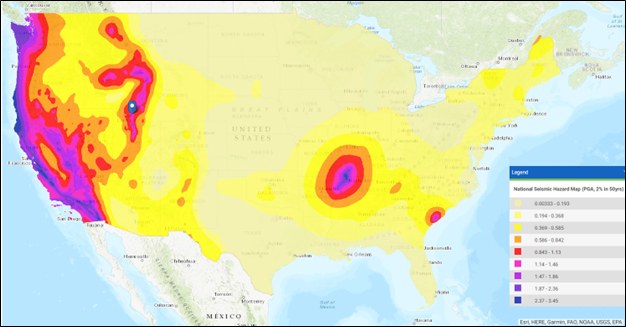
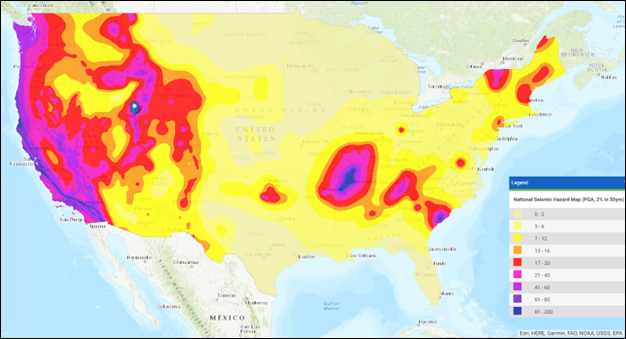
Risk-Targeted Maximum Considered Earthquake (MCER) Spectral Response Acceleration Parameters Maps: The maps for SS, S1, SMS, & SM1 have been revised. The bulk of these revisions occur in the Western US & the region known as the New Madrid Fault. From the ASCE Hazard Tool website, the following heatmaps show the changes to National Seismic Hazard Map (PGA, 2% in 50yrs). Both Figure 1.1 & 1.2 are for an Occupancy II building in Site Class D. Figure 1.1 is the new map for ASCE 7-22 while Figure 1.2 is the old map for ASCE 7-16. The updates in values are from the most recent USGS Seismic Design Geodatabase. This is why it is important to get new seismic values if your project is going from a previous IBC/ASCE version to IBC 2024/ASCE 7-22.
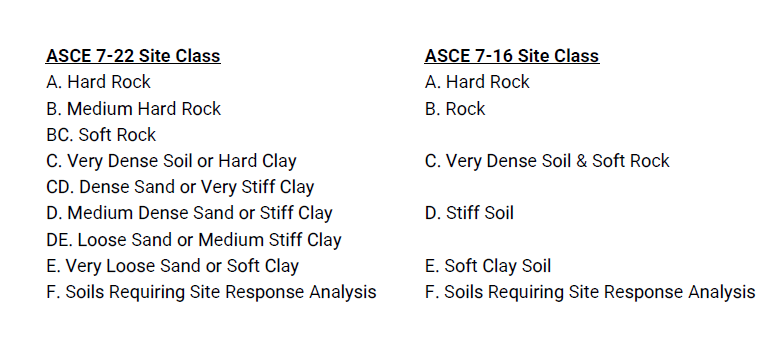
Site Class: ASCE 7-22 introduced new site classes that align more closely to those found in the field. The new site classes expanded to cover more soil types as well. The purpose of a site class is to account for how seismic waves move through rock, soil, sand, & clay differently. Because of the different soil properties some site classes will help your seismic design while others will hurt it. Table 1 below shows the difference between the new ASCE 7-22 site classes vs the old ASCE 7-16 site classes. Remember that determination of what site class to use is usually listed in the project specifications given by the Engineer of Record or determined by the Authority Having Jurisdiction, not American Buildings.
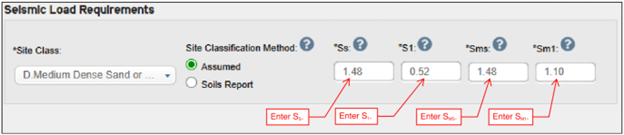
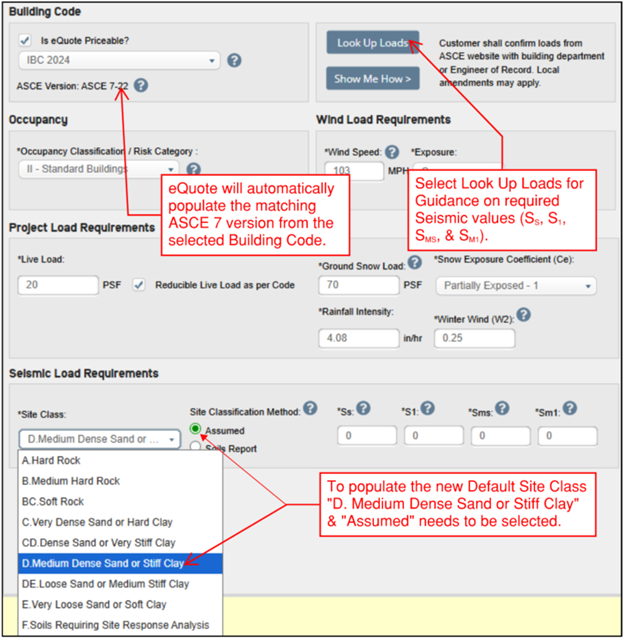
Default Site Class: In addition to the new site classes ASCE 7-22 introduced a new default site class. This change is to encompass the vast majority of site soil conditions without requiring a Geotechnical Site Response Analysis to be performed. The new ASCE 7-22 default site class is now known as “Assumed C, CD, or D” compared to the old ASCE 7-16 default site class of “D Assumed”. The new site class “Assumed C, CD, or D” encompasses the most critical spectral response acceleration at each period for site class C, CD, & D. It can be used unless the Authority Having Jurisdiction or Engineer of Record requires site class DE, E, or F.
Mean Roof Height Limit for Common Steel Framing Solutions: ASCE 7-22 did not have many changes to the height & loading limits for common steel framing solutions used in PEMB projects. American Building’s typical primary force resisting system is accomplished through a standard Post & Beam/X-bracing (OCBF) and Rigid/Portal Frame (OMF). There are times when these framing systems are not permitted, as shown in Table 2 below. Alternate framing systems: IMF (Intermediate Moment Frames), SMF (Special Moment Frames), and BRBF (Buckle Restrained Brace Frames) increase the limitations, but come at a price. The use of these framing solutions requires additional review and approval.

eQuote Walkthrough
Now, we’ll outline how loading entry works in our eQuote Tool. Use these steps as a guide while entering in loading information on your project.
Building Code Entry
When it comes to loading for your project ALWAYS consult the Engineer of Record &/or the Authority Having Jurisdiction for exact loading on your project.
Using ASCE Hazard Tool
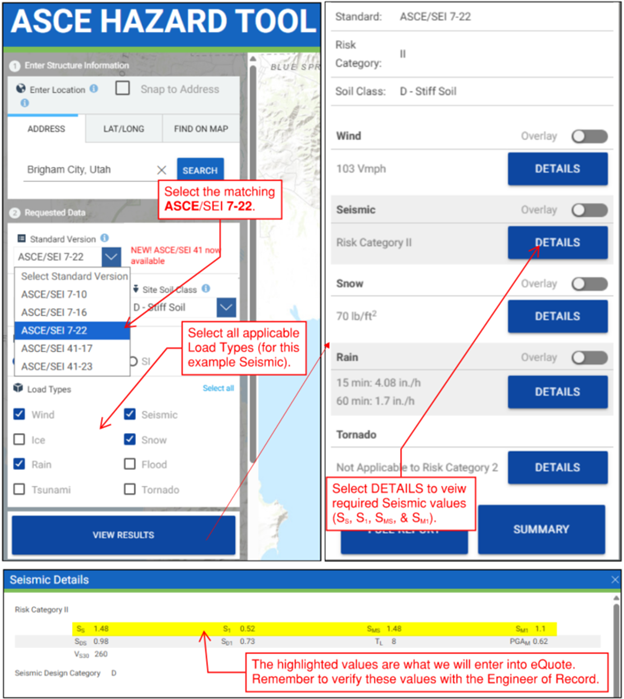
Entering Information Back into eQuote